
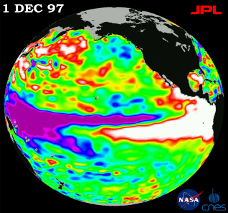
Since the beginning of 2014 we regularly hear about the return of "El Niño" in the central Pacific Ocean, ie the ENSO (El Niño southern oscillation). Its most serious effects are expected at the end of the year and many questions are rife about the importance and consequences of this climate phenomenon in tropical agricultural productions and cocoa in particular, should not be spared.
This climatic irregularity has been well studied on the North West Coast of South America where is observed, as a result of warming surface waters of the Pacific and decrease in atmospheric pressure, a rise in temperature and unusual rainfall of importance and even devastating in the North of Peru and Ecuador. But El Nino has global consequences especially in tropical regions of the world where grows cocoa. It also causes severe drought there (South East Asia and North-eastern South America) and also devastating tornadoes (Caribbean, Central Pacific).
At Wasi manta, which is located in the eastern foothills of the Andes, influences from West Pacific and Andean as well as Eastern Atlantique and Amazon are alternately felt. The combining of these two systems, which determines a wet season from December to April and a less rainy and hot season for the rest of the year, is generally beneficial as the cocoa is watered thanks to the natural rain showers and is then able to dry through sunshine, process beneficial to the aromatic composition of the cocoa beans.
With the arrival of El Nino we can therefore fear the difficulties resulting from a surplus or a drastic shortage of rain: development of fungal diseases, slower maturation of pods, and complications for fermentation and drying in case of too much rain during and especially after the wet season. On the opposite of persistent drought, a volume loss in fruiting and weakening of trees, especially the youngest, who is obvisouly feared. In conclusion, we have not yet finished hearing of "El Nino".


